Think You Should Be “Over It” by Now? A Wakefield Therapist Says Otherwise
The Myth of “Getting Over It”

Feeling like it is too hard to move on? Consider how therapy in Wakefield can help take a more personal approach to living with change.
Most people who have suffered from a major disappointment in life feel a certain pressure to “get over it” at some point in time. Sometimes this pressure is external and people around them are telling them that it’s time to “move on,” and sometimes the pressure is from within, and people kick themselves for not having “moved on” yet. Either way, it is very unlikely for anyone to “get over” or “move on” from grief simply because there is pressure to do so. Instead, that pressure is actually more likely to make them stuck because they feel shame and are distracted by all the self-doubt that the pressure introduces.
Grieving and transitioning happen on their own individual timelines. Healing is almost never linear, nor does it follow struct timelines. Emotional pain simply does care, it only cares about honoring what is lost. So what are you to do if you feel stuck? Therapy with a therapist in Wakefield can help you honor your unique grief and distress in ways that help you feel like you can adapt to your new reality more easily. Instead of “moving on,” you can learn to move forward in your new reality.
Understanding Why Some Challenges Take Longer
Sometimes, people are able to integrate very challenging disappointments with relative ease. They may feel well-supported by their community, they may feel like the loss is something relatively relatable with others and even though they are upset by the change, they can see the path forward.
Other times, people feel almost paralyzed by loss and transition. This is more likely to happen if there is a long history of significant, cumulative losses, if the loss is experienced in isolation, if it is a loss that is not understood well or is invisible to others, if the community is not necessarily supportive or concerned and also if there is a personal predisposition to getting ruminative and isolated during challenges.
As a therapist in Wakefield, I have supported many people through both the easier and the harder transitions, and I have experienced the range myself. The amount of struggle someone has is not necessarily proportionate to the relationship with what is lost, because the struggle reflects so many other factors. With death, it is actually more common to get stuck in grief when there has been a conflicted relationship with the person who died than when there was a clear and easy relationship. Have complex feelings before the loss only carries that complexity forward into grief.
In therapy, you can have the opportunity to explore some of the reasons that might be creating challenges for you and by understanding this dynamic better, you might find more compassion for yourself in the process. The last thing you need when you are upset is to beat yourself up too! You can also start to understand where you feel that you are getting stuck in an open and compassionate way, that allows you to think more clearly about how to move forward in a way that feels right to you.
Common Emotional Responses That Persist
People often think of the classic “five stages of grief” and these are important to understand to know how common they are, yet they are not actually meant to be what grief looks like. Somewhere along the development of the literature on grieving, these stages were misinterpreted to be what people experienced when grieving a death, but they were actually identified as the ways in which people respond to their own terminal illness, and the author has been clear that they stages are not linear, nor is every step expected for every person.
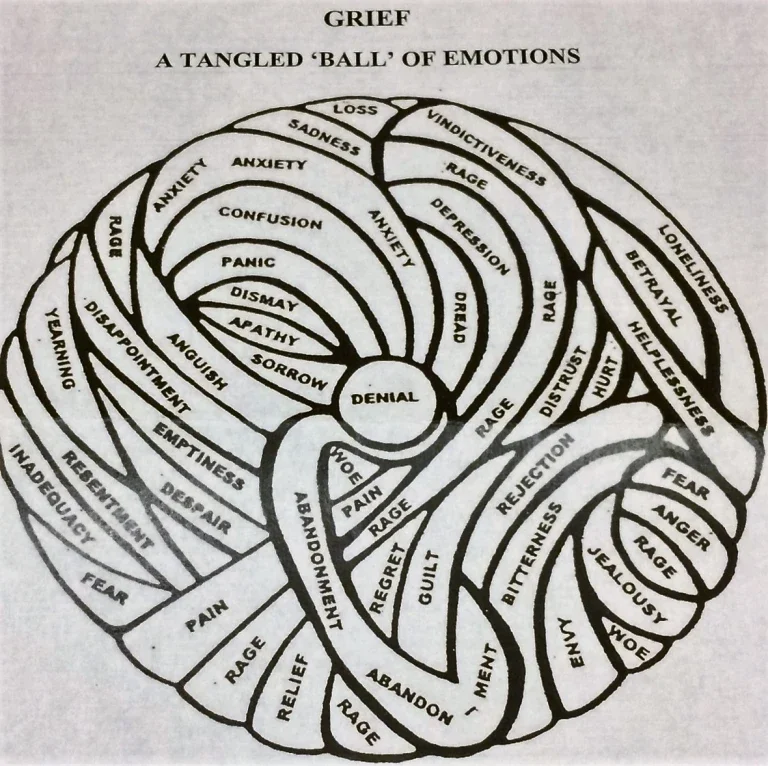
The tangle of grief - consider seeing a therapist in Wakefield to help navigate
Instead, I often like to reference this image of the “tangled ball of emotions” that can be grief. Any emotion is okay and they are going to course in and out of awareness over time. Most people have a few prominent feelings that are unique to them. Anyone is at risk for getting stuck or having one feeling really take over in ways that can be incredibly burdensome. Therapy can be a really helpful place for understanding these feelings and what they represent. Therapy can help make room for other, more complex feelings that feel more nurturing and allow for integration more easily.
The Danger of Suppression and Minimization
Yes, there may be times when it is appropriate to push down challenging feelings. Work is a big one, and if you are a parent, there may be spaces in parenting when it actually is adaptive to put your challenging feelings aside and focus on the task at hand. Yet doing this too often or without a reprieve can actually cause more harm in the long run. After all, those challenging feelings demand their time, and they will wait until they get it! Better to give them their air time on your own terms. What can be hard is that if you “push through” for too long, you might find it almost impossible to them summons those feelings when you feel like you have the time and wherewithal to process them.
I suggest finding small ways to integrate the tough feelings amidst the “pushing down” times. Whether this is a moment in your car before you commute home from work to reconnect with the feelings, a pause while you are eating lunch, or a quick walk in the evening where you let your thoughts wander, it can help not to let the feelings get too far, while also not letting them intrude into spaces where they are deeply unwelcome. Pushing them aside for too long can lead to irritability, difficulty sleeping and other challenges that are signs you need more support because the feelings start to sneak out in other ways. Therapy can be very helpful for identifying ways that feel manageable to connect with these feelings.
Redefining What “Healing” Means
Instead of defining healing as “moving on”, “letting go” or “getting over” something, I urge you to consider what actually feels most meaningful to you. I often like to think of “moving through,” “moving forward,” or “living with” as terms that are more realistic and more respectful of the loss. After all, why would we want someone to cut ties with something or someone for which they cared deeply? Often the real goal is to simply not have this be the most prominent aspect of life, not to actually get rid of it entirely.
Recognizing when progress happens is really important along the way, and assume that there will be ups and downs. I don’t like to think of these as regressions or as setbacks, but instead, as expected curves along the way. After all, it would be rather robotic to move forward without ever looking back.
To take a quick personal example, I am a big cat lover (actually dogs too, but kitties have been special for me since I got my first at two years old) and I have an amazing brother/sister duo since after I graduated college and into my mid-thirties. My “Little Girl,” as she was known, was the sweetest and most loving kitty I have ever had and I was naturally really sad when her time was up and I had to say goodbye. I have always thought of her really fondly since that time. A few months ago, I was in a pet store with my kids where we often stop to go look at the cats awaiting adoption (I don’t know why I do this to myself!) and there was a cat there with markings that were very similar to the Little Girl, which were really unique. I was taken aback by the similarity and very uncharacteristically cried immediately when I saw this sweet kitty because I missed my Little Girl so much. As you can imagine, me kids were utterly amused by this as I took a few minutes to reorient myself! This could be seen as some sort of “unresolved grief” or a setback, but I didn’t see it that way at all. I saw it as a natural, poignant moment when I came face to face with someone I missed dearly, and was struck by just how much I missed her and how much I had appreciated her in my life. Instead of feeling ashamed by my reaction, it felt like a really nice way to connect with and honor just how sweet of a kitty she had been and how much I enjoyed our years together.
Healing can be continuous, and once you expect this and reduce the shame over how you feel, you may find you stop fighting certain feelings and actually get to process them in ways that are more helpful.
When to Seek Help From a Therapist in Wakefield
With all the gentleness I encourage around handling tough transitions, I also want to be clear that more help can be important when things feel stuck. While there is no magical formula for when someone should feel “better,” there is often a visceral awareness if something has been too hard for too long. Getting professional feedback can be really helpful if you are facing a lot of internal or external pressure around “getting over” something to learn if you are stuck or if expectations need to be adjusted.
If you find yourself persistently withdrawing from others, having changes in your appetite or disruptive sleep, it may be time to seek more help. Certainly, if you feel like life is no longer worth living, you will want to get help right away. If you are ready to move forward and simply can’t find a path, consider seeking help from a therapist in Wakefield to help start you on the way with a personalized plan that feels right to you.
Healing isn’t a race. If you feel like you “should be over it” but aren’t, a therapist in Wakefield can help you move forward at your own pace. Contact me to schedule a free consultation.
Whether you are entering therapy for the first time or looking to reconnect with the process, I offer a welcoming, supportive space to explore your challenges and goals.
With the flexibility of in-person and online therapy, we can find a space for therapy in your lifestyle and schedule.
Are you ready to take the next step?
Let’s connect over a free, 15-minute phone consultation for therapy in Wakefield